
Hacking a Lite RPG Framework
just like with peanut butter, I like my mechanics creamy, not crunchy

The subtitle of this post may make you laugh, when you get to reading the specifics on my mechanics. But I maintain that they’re still an order of magnitude simpler than something like 5th edition AD&D, or Hackmaster.
So I’ve made a New Year’s resolution to engage in solo-roleplay consistently throughout 2026.
Do I have the time to devote to this? Yes, on average my wife and I consume about four hours nightly of Netflix or one of its analogues, and I’m rarely as interested in what’s on that screen as I am in what’s on my laptop’s screen.
I shared in my previous post that I’ve come to prefer less crunchy, more narrative-forward mechanics, but I still enjoy rolling dice. Therefore, before Christmas I began perusing free RPG systems. When it comes to these, itch.io is gold. I found chaosgrenade’s Awesome Dice Pool System, and hacked it.

Mechanics
PCs and NPCs have three Attributes that range in value from 1 (below average) to 5, maybe 6 (human peak). The three attributes of humanoids are: Body, Mind and Spirit. Stenn’s Attributes at the time of character creation are:
- Body 3 (above average)
- Mind 3 (above average)
- Spirit 4 (exceptional)
Most NPCs’ Attributes’ values sum to 7-8. Focal NPCs may have Attributes summing to 9, 10, or even higher.
Each of the three Attributes (Body, Mind, and Spirit) has a Stress Track associated with it. The Stress Track has a number of checkboxes equal to that Attribute’s value.
In addition to Attributes, your character starts play with up to three Traits. Traits are personal characteristics, positive or negative, that either add or subtract a die from the Dice Pool when the relevant Trait is applicable.
My character, Stenn, has a trait called Thuggishly Strong that he can use in combat Resolution Rolls.
Resolution Rolls
When rolling a pool of six-sided dice, you are making a Resolution Roll, and all 5 and 6 results are Successes.
Conflicts (such as combat) are handled by having the participants declare what they’re doing and comparing Resolution Rolls against their opponents. This means sometimes it is advantageous for the players to Help one another.
When Helping, both you and the person you’re helping make a Resolution Roll and then you get to apply the better (i.e., the roll with more Successes).
Any ties during a conflict scene are either a stalemate or moot point – this may be an opportunity to role-play a truce or back off the opposing side (or a chance to exchange crude remarks).
A character that (a) succeeds a Resolution Roll in a conflict and (b) whose total successes (count all 5’s and 6’s rolled) exceed those of his adversary/circumstance, gets to narrate how the result of their action either causes Stress or inflicts a Hindrance on their opponent, or how they overcome some circumstance.
Stress harms the targeted character, dealing a number of ticks to their Stress Track equal to the difference in Successes. Opponents only have 1 track; player characters have a track for each Attribute. Mark a tick by a single cross-slash on a box; each box may take 2 ticks (creating an “X”).
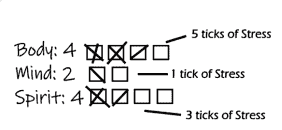
- Physical harm deals stress to the Body attribute.
- Insanity, magic or psychic trauma harms the Mind attribute.
- Intimidation, fear, & demoralization affects the Spirit attribute.
Most NPCs’ Attributes’ values sum to 7-8. Focal NPCs may have Attributes summing to 9, 10, or even higher.
Each of the three Attributes (Body, Mind, and Spirit) has a Stress Track associated with it. The Stress Track has a number of checkboxes equal to that Attribute’s value.
In game terms, conflicts (such as combat) are handled as any other action, with participants declaring what they’re doing and comparing Resolution Rolls against their opponents.
Any ties during a conflict scene are either a stalemate or moot point – this may be an opportunity to role-play a truce or back off the opposing side (or a chance to exchange crude remarks).
A character that (a) succeeds on a Resolution Roll in a conflict and (b) whose total successes (count all 5’s and 6’s rolled) exceed those of his adversary/circumstance, gets to narrate how the result of their action either causes Stress or inflicts a Hindrance on their opponent, or how they overcome some circumstance.
Stress harms the targeted character, dealing a number of ticks to their Stress Track equal to the difference in Successes. Opponents only have 1 track; player characters have a track for each Attribute. Mark a tick by a single cross-slash on a box; each box may take 2 ticks (creating an “X”).
When a given Attribute’s Stress Track is filled, your character is out of the action (defeated, killed, rendered unconscious, captured — whatever outcome the Gamemaster decides — or that perhaps the Mythic Game Master Emulator 2.0 decides, if you use that tool).
Obviously, that isn’t something you want to happen to your character. Fortunately, your character begins play with a number of Adversity Tokens equal to their Spirit attribute.
When a player fails a roll against the Judge/GM/Oracle, they receive 1 Adversity Token. They can spend a token on any Resolution Roll – theirs or any allies – to add +1 die against the Judge. Any number of tokens can be applied to a single roll. Remember: at any given time, you can never have more Adversity Tokens than X, where X is the value of your Spirit attribute.
In addition to the single Adversity Token that the PC receives when failing a Resolution Roll, s/he also gets one Adversity Token for each pair of doubles in the failed roll.
Example: Stenn fails his Resolution Roll (it has fewer Successes than the GM’s). The dice come up as follows: 5, 3, 5, 6, 2. That’s 3 Successes (5’s and 6’s are successes). Unfortunately, the GM’s opposed Resolution Roll comes up with 4 Successes. Stenn has lost the Resolution contest. Stenn gains one Adversity Token for the failure, plus another for the pair of 5’s.
What if Stenn had failed his Resolution Roll and the dice came up as follows? 5, 3, 5, 5, 3. How many additional Adversity Tokens would he gain? Two (pair of 5’s, pair of 3’s). The third 5 isn’t part of a pair/double.
The Luck Die
Special Traits – like magical items, high-tech augmentations, or supernatural senses grant a Luck Die.
This is a unique die that stands out from the rest of the dice in the Dice Pool. In addition to providing an extra die to a pool, the die adds the following benefits:
• If the player rolls a Success on the Luck Die and wins the Resolution Roll, the player gets to narrate a Boost — a bonus effect to the intended result of their action. Whenever the player narrates a Boost, add +1 to Experience (XP).
• If the player lost the Resolution Roll, but still scored a Success on the Luck Die, then a Slip occurs. A Slip means the character didn’t succeed as intended, but the Player still gets to narrate an opportunity that arose from their misfortune. Alternatively, the character may exchange the Slip for one Adversity Token.
In addition to spending an Adversity Token to add +1 die to the Dice Pool for a single Resolution Roll, you may also spend an Adversity Token to clear one tick on an Attribute’s Stress Track.
Limitations of Traits
You may not through meta-gaming cleverness gain unfair advantage from multiple Traits. You cannot, for instance, assign traits of Smart, Agile, and Strong and then argue that all three come into play for each and every feint, thrust, dodge, thrust, and parry in a melee.
You could, however, reasonably assert that Smart applies to an attempt to solve a maze, that Strong applies when attempting to bend bars, or that Agile applies when jumping a crevasse.
Advancement
At the end of a Scene, award +0.1 XP; if you are playing solo and the write-up of the scene (narrative, in the vein of solo-rpg journaling games, or due to combat and lots of dice rolls for mechanics) is fairly lengthy, instead award anywhere from 0.25 XP to 1.0 XP.
Advancement occurs in two ways: spend 2 XP to add a new Trait. This cannot be an alternatively named clone of an existing Trait. Don’t try to add Brutish Biceps if you’re already Thugglishly Strong. If you aren’t playing solo, then the referee must approve the Trait and ensure you both agree regarding its scope/limitations. This must be supported by the solo-roleplay narrative/journaling. Remember, a Trait should be fairly narrow, and it adds +1 to the Dice Pool when its use is relevant.
The other way to Advance is to improve one or more of your three Attributes (Body, Mind, Spirit). Body and Mind in NPCs can ordinarily only be improved up to a value of 5 — maybe 6. But for a PC or unique/boss NPC, this limit may be exceeded.
More commonly, if powerful science or magic is involved in bolstering a physical or mental process, it would fall under the category of a special, Luck Die providing Trait.
In a game with a DM and only a single player, or if you are playing solo via an oracle, it’s recommended that Body and Mind be improvable beyond 5 or 6, but that this can only occur if the new, improved Attribute value, when doubled, would not be greater than your Spirit attribute.
For instance, imagine a character has been adventuring for a long time, and has Body 4, Mind 3, and Spirit 7. Assume the player has enough XP to raise either Body or Mind. The player could only raise Mind to 4 and not Body to 5 (raising Body to 5 would require that the Spirit attribute already be 10+).
You may improve your Spirit attribute indefinitely, so long as you can pay the increasingly expensive XP cost.
To incease an Attribute, spend a number of XP equal to the Attribute’s *current* value. As Spirit improves over the long-term course of play, it’s Stress Track grows accordingly, as does the cap of Adversity Tokens.
If you would gain an Adversity Token but you already have the maximum allowed (X, where X equals the current number of un-ticked boxes in your Spirit track), instead convert it to 0.1 XP.
If a situation calls for a Resolution Roll but does not permit the PC to apply whatever special Trait allows for Luck Die inclusion, the PC may choose to Push His/Her Luck. Include the Luck Die in the Resolution Roll, but if it comes up a 1 or 2 (regardless of whether the overall Resolution Roll succeeds or not), you have Blundered.
On a Blunder, something negative in the narrative happens and you don’t gain the usual +1 Adversity Token for the failed Resolution Roll.
Sources of Adversity Tokens:
- failing a Resolution Roll against the GM or Oracle without Blundering (+1 token)
- converting a Slip (+1 token) - slips occur on failed Res roll but Luck Die is a Success
- per pair (i.e., doubles) that comes up when a Resolution Roll is failed (+1 token)
Sources of XP:
- from converted Adversity Points (+0.1 XP)
- from completing a Scene and its write-up (+0.1 to T1.0 XP)
- from getting a Boost on a Luck-die success on a successful Resolution Roll (+1.0 XP)
Uses of Adversity Tokens:
- clear a single tick on a given Attribute’s Stress Track (costs 2 Adversity Tokens)
- add +1 die to Dice Pool (per Adversity Token spent) for a single Resolution Roll
When a given Attribute’s Stress Track is filled, your character is out of the action (defeated, killed, rendered unconscious, captured — whatever outcome the Gamemaster decides — or that perhaps the Mythic Game Master Emulator 2.0 decides, if you use that tool).
Obviously, that isn’t something you want to happen to your character. Fortunately, your character begins play with a number of Adversity Tokens equal to their Spirit attribute.
When a player fails a roll against the Judge/GM/Oracle, they receive 1 Adversity Token. They can spend a token on any Resolution Roll – theirs or any allies – to add +1 die against the Judge. Any number of tokens can be applied to a single roll. Remember: at any given time, you can never have more Adversity Tokens than X, where X is the value of your Spirit attribute.
In addition to the single Adversity Token that the PC receives when failing a Resolution Roll, s/he also gets one Adversity Token for each pair of doubles in the failed roll. Example: Stenn fails his Resolution Roll (it has fewer successes than the GM’s). The dice come up as follows: 5, 3, 5, 6, 2. That’s 3 successes (5’s and 6’s are successes). Unfortunately, the GM’s opposed Resolution Roll comes up with 4 successes. Stenn has lost the Resolution contest. Stenn gains one Adversity Token for the failure, *plus* another for the pair of 5’s.
What if Stenn had failed his Resolution Roll and the dice came up as follows? 5, 3, 5, 5, 3. How many additional Adversity Tokens would he gain? Two (pair of 5’s, pair of 3’s). The third 5 isn’t part of a pair/double.
Well, that’s an overview of the mechanics. Don’t be chagrined if you don’t instant grock the whole of it. If you follow along in my future Actual Plays, you’ll see that you’ll come to grips with it quickly.
Now that I’ve outlined the mechanics, here is Stenn Bearclaw’s character sheet. I’ll give you a chance to read about Stenn, and then we’ll have our first Actual Play!